Overview
The State of California’s unique geographic and demographic characteristics offer both challenges and opportunities for meeting rail operations and related workforce development priorities. At 163,700 square miles, California is the third largest state in the U.S. by area. Its size, in addition to its major ports, industrial corridors, and agricultural centers, creates significant demand for freight rail service and an extensive transportation network. At the same time, maintaining and staffing rail operations across diverse geographic regions, from major urban hubs like Los Angeles to rural areas in the Central Valley, requires a large and sustainable workforce with both technical and operational expertise. Passenger rail aspirations across the state, including California High Speed Rail, Brightline West, and new construction in Los Angeles County, all demonstrate an appetite for rail transportation – which will require a skilled workforce to deliver.
California already has nationally significant workforce development models that demonstrate how education, training, and workforce development initiatives can be aligned with rail industry needs. The Rail Academy of Central California (TRACC) reflects a strategic partnership between a regional rail commission, a community college, and public and private rail operators that prepares students for careers in freight and passenger rail operations through industry-informed curriculum and hands-on training at active rail facilities. The Santa Clara Valley Transportation Authority (VTA) and the Amalgamated Transit Union (ATU) Local 265’s Joint Workforce Investment (JWI) initiative reflects the strength of labor-management partnerships. California has numerous successful logistics workforce education programs that could also provide a model for the rail industry, including the Academy of Global Logistics at Cabrillo High School and the Global Logistics Professional certification, both housed in Long Beach. Models like these hold considerable potential in connecting emerging rail professionals with promising career opportunities in designing, developing, operating, and maintaining the future rail infrastructure in California. The question before us concerns the ways in which the models and programs we have already can be improved, scaled, and replicated statewide to meet the demands of industry.
To ensure that the California workforce is prepared to meet the ever-increasing freight volumes on the one hand and the demands of ambitious passenger rail expansion on the other, strategic talent-pipeline programs must be implemented across the state to address widespread retirements and new skills gaps associated with transformational technologies. Workforce development pressures are intensifying as California transitions to battery-electric and hydrogen-powered locomotives, especially in railyards, ports, and trade corridors. Zero-emission freight rail introduces entirely new skill requirements, including high-voltage systems, energy storage, hydrogen handling, fueling and charging infrastructure, and advanced diagnostics. At the same time, new safety and efficiency technologies—such as Positive Train Control (PTC), drones, and data-driven asset management—are changing how freight railroads operate and maintain their networks.
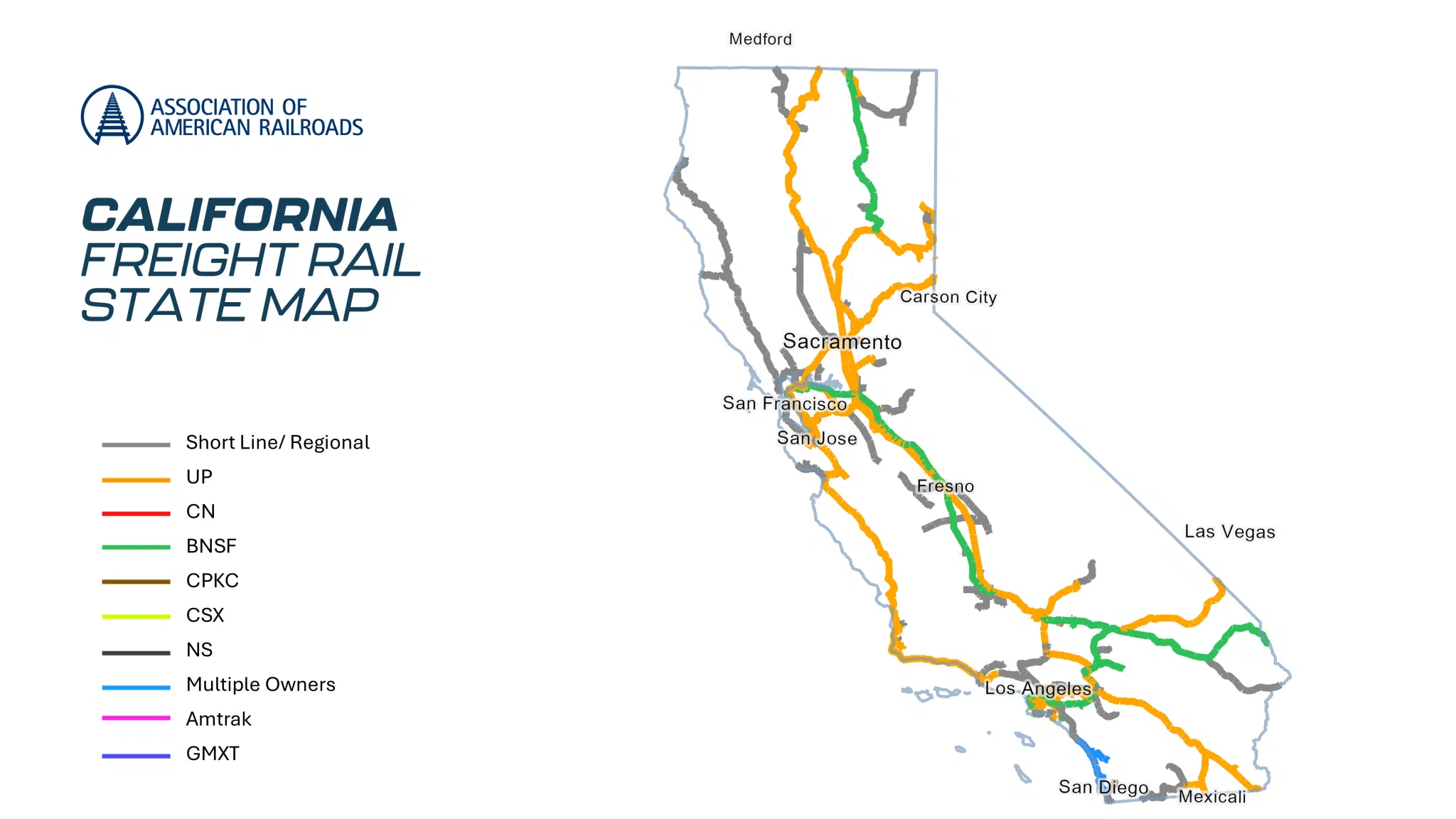
Why Rail Matters to California
- 27 freight railroads operate over 4,985 miles of track and employ 6,885 workers, connecting 11 ports, Mexican border trade, Inland Empire manufacturers and distribution centers, and the state’s extensive agricultural sector
- Passenger rail agencies employ approximately 29,132 people and Amtrak employs 1,647 people in the State of California
- Government agencies and major logistics employers (such as the Port of Long Beach) have acknowledged rail as a crucial component of reducing air pollution, mitigating climate change, reducing traffic congestion, and enhancing supply chain resiliency
Workforce Gap
- Rail workforce participation in California has been shrinking for decades, and it is expected to continue declining due to aging demographics
- California’s ambitious plans for high-speed passenger rail and alternative fuels generate demand for new skills and qualifications, in addition to workforce needs generated by the expansion of traditional freight and passenger rail
- Despite its large population, competition among industries for qualified workers in California is high. At the same time, rural areas in the Central Valley, Inland Empire, and far northern counties often face shortages of workers willing to relocate or commute for rail-related occupations that require field operations, shift work, and technical expertise
- Limited rail-specific training and education opportunities make workforce gaps an increasing issue for the industry
- Current workforce education and university partnerships must be enhanced and scaled to meet statewide industry needs
Why this Project Matters
- Expand awareness of rail career pathways for K–12 and college students through integration with high school career pathway programs, creation of outreach materials, and extracurricular opportunities
- Develop multidisciplinary project-based rail curriculum aligned with emerging technologies and sustainability goals for secondary and post-secondary students
- Strengthen partnerships between rail employers, universities, organized labor, community colleges, and workforce agencies.
- Increase internships, apprenticeships, and work-based learning opportunities
- Build long-term workforce pipelines to support California’s expanding freight and passenger rail opportunities
California Multisector Working Group
Project strategies and implementation will be guided by a Multisector Working Group. The working group is made up of industry, labor, education, and workforce representatives from across the state and region. They will assist the team in identifying workforce development needs, skills gaps, and training and education priorities, and will help engage educators across the K-12 and post-secondary education continuum in project activities.
Alex Lewis
Co-Treasurer, College Outreach
Railway Association of Southern California
Asha W. Agrawal
Education Director
Mineta Transportation Institute, San Jose State University
Brian Carr
General Chairman
Brotherhood of Locomotive Engineers and Trainmen
Christine Casey
Deputy Secretary, Freight Policy
California State Transportation Agency – Freight, Rail, and Border
Donald (Don) G. Norton
Executive Director
California Short Line Rail Association
Fran Inman
Senior Vice President
Majestic Realty Co.
Jeremy Lee
Associate Deputy Director, Industry Engagement & Development,
Governor’s Office of Business and Economic Development
Kevin Matulich
Deputy Secretary, Clean Economy and Infrastructure
California Labor & Workforce Development Agency
Megan Craig
Rail Services Coordinator
San Joaquin Valley Rail Commission
Michael Cano
Deputy Executive Officer for Goods Movement Planning and State Policy and Programming
Los Angeles County Metropolitan Transportation Authority
Otis Cliatt
President,
Pacific Harbor Line, Inc.
Danny Vilicich
President, Local 63
International Longshore and Warehouse Union
Noelia Rodriguez
Chief of Staff
Southern California Regional Rail Authority (Metrolink)
Shannon Simonds
Chief, Office of Rail Planning & Implementation
Caltrans Division of Rail
Wes Lujan
Vice President, Government & Industry Affairs
GATX Corporation
John Gregory Green, PhD, PE, PEng
Department of Civil & Geomatics Engineering
California State University, Fresno
Chairperson, Committee on Education and Professional Development
American Railway Engineering and Maintenance-of-way Association (AREMA).
Roger Nober
Affiliated Scholar, Regulatory Studies Center
George Washington University
Elizabeth Lewis
Senior Recruiter
Union Pacific Railroad
N’guessan Affi
Freight Policy Manager
California State Transportation Agency (CalSTA)
Allison Joe
Deputy Secretary, Workforce
California State Transportation Agency (CalSTA)
Anthony Serna
Deputy Secretary for Rail and Transit
California State Transportation Agency (CalSTA)
Jess Guerra
Executive Director, Transportation Workforce Institute
Chair, Advanced Transportation and Manufacturing Pathway at Los Angeles Trade-Technical College